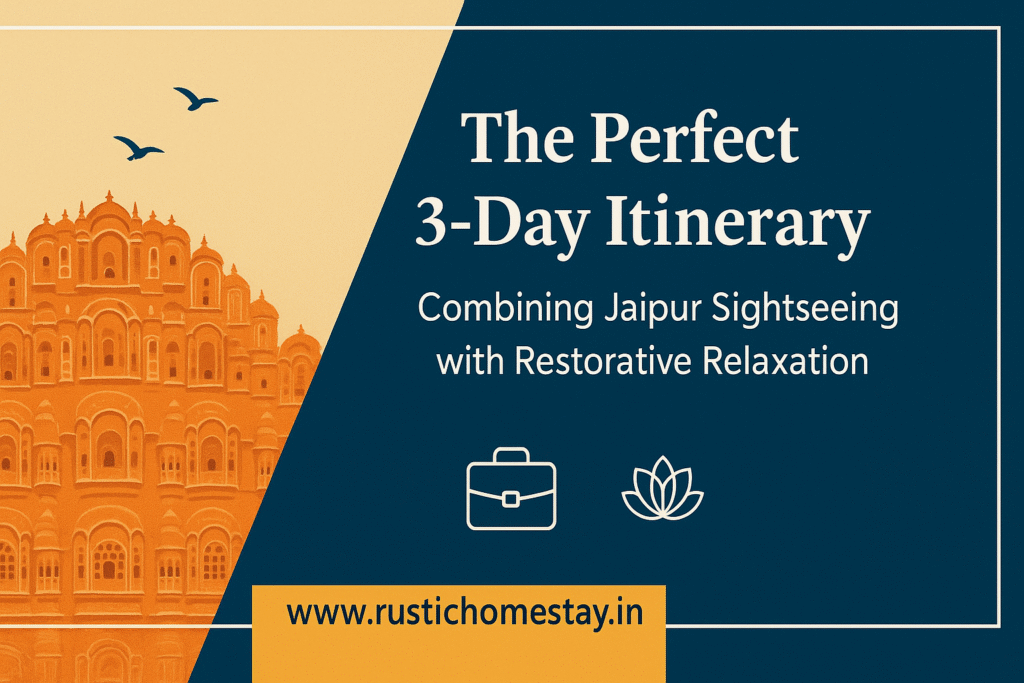
Jaipur is dazzling, vibrant, and, frankly, exhausting. The rush of the palaces, the bustle of the bazaars, and the sheer volume of history can leave you feeling more drained than inspired. Most travel guides offer a frantic checklist, pushing travelers to cram five days of activity into three, resulting in sensory overload. This Jaipur 3 day itinerary, however, is built on a different philosophy: Slow Travel.
The secret to truly enjoying the Pink City lies not in rushing through a checklist, but in balancing the high-energy sightseeing with dedicated moments of rest. You need a trip that is equal parts magnificent fort views and restorative peace. We believe that true travel is about absorption, not accumulation. It’s about being able to sit still and recall the moment—the sound of the breeze at a fort’s parapet or the taste of traditional chai—without the haze of fatigue.
We’ve designed the perfect three-day itinerary that shows you the best of Jaipur while ensuring you get the quiet downtime you need to truly appreciate it. It is structured to front-load the energy expenditure and intersperse reflection, ensuring you leave Jaipur feeling replenished, not depleted.
Table of Contents
ToggleDay 1: Majesty, History, and a Peaceful Sunset
Day one is dedicated to the historical giants that define Jaipur’s reputation, followed by a quiet, reflective evening. This day focuses on the northern periphery of the city, where the Aravalli hills provide natural grandeur and escape.
Morning (High Energy: Fort Exploration)
Start your day early—ideally by 8:00 AM—and head straight to Amer Fort (Amber Fort). This is Jaipur’s showstopper, located about 11 kilometers outside the main city. Arriving early is essential to avoid the harsh midday sun and the major crowds.
Diving Deeper into Amer: Amer was the original capital of the Kachwaha clan until 1727. Its architecture is a stunning fusion of Rajput and Mughal styles. Don’t just rush through the main courtyards; dedicate time to these specific, less-crowded areas for a sense of peace:
The Sheesh Mahal (Mirror Palace): While popular, the intricate mirror work in the Hall of Mirrors is worth contemplating. Its design ensured that a single candle could light the entire chamber, a testament to 17th-century engineering.
The Zenana (Women’s Chambers): Located on the fourth level, these interconnected chambers were designed for the royal women, allowing them to communicate and move without being seen by men outside their family. The quiet complexity of these narrow passages offers a genuine sense of solitude.
The Diwan-i-Aam and Diwan-i-Khas: The Hall of Public Audience and Hall of Private Audience, respectively, showcase the power and grace of the past. Imagine the royal decrees being issued here, then step back and let the silence take over.
Spend at least two hours exploring the complex, from its grand courtyards to the intricate Sheesh Mahal.
Practical Tip: Skip the elephant ride, which can be stressful for the animals and often involves long queues. Hire a jeep or walk the easy climb for a more direct, peaceful start to your day.
Afternoon (Mid Energy: Craft & Cuisine)
After the intensity of the fort, a moment of slow cultural immersion is needed. Treat yourself to a relaxed, long lunch in the Amer area.
Instead of rushing back to the city, explore a local, less-crowded craft cluster nearby. Jaipur is world-famous for its artisans.
Block Printing Workshops: Visit a workshop in the nearby town of Sanganer or Bagru. Here, you can witness the mesmerizing, rhythmic process of hand block printing. The quiet focus of the artisans applying wooden blocks to cloth is meditative, shifting your focus from historical grandiosity to the beauty of contemporary craft. This is an active form of restoration.
Traditional Dining: Seek out a garden restaurant or an authentic Rajasthani thali place slightly outside the tourist track (look for establishments known for their ambience, not just rapid turnover). Enjoying a slow meal, away from the horns and the crowds, allows your mind to process the morning’s sights.
Consider a quick visit to a local pottery or block printing workshop for a calming, hands-on experience that shifts your focus from crowds to creation.
Evening (Restorative: Views and Calm)
Your first day must end with complete tranquility. Instead of going back to the crowded areas of the city center, choose a panoramic, quieter viewpoint.
Option 1: Nahargarh Fort Sunset (The Gold Standard): Head up to Nahargarh Fort well before sunset (about 90 minutes before the actual sunset time). Perched high on the Aravallis, it offers breathtaking, 360-degree views over the entire Pink City. The fort is quieter than Amer and allows for true reflection. Find a quiet spot on the western walls and simply watch the chaos of the city fall silent as the sun goes down, casting a golden hue over the historical centre. This is a must-do for photographers and seekers of peace.
Option 2: Jal Mahal Viewpoint (Passive Peace): A relaxing drive past the serene Jal Mahal (Water Palace) at dusk offers a beautiful photo opportunity and a moment of quiet contemplation over the man-made lake. You cannot enter the palace, which ironically makes the experience more peaceful—it’s purely about observation and stillness. The subtle lighting of the palace across the water provides a magical, calming end to Day 1.
Day 2: City Culture, Hidden Markets, and Inner Peace
Day two focuses on the heart of the Pink City and trading the loud, main bazaars for quieter, specialized experiences. We dive into the architecture and history of the core, but prioritize escaping the shopping frenzy.
Morning (High Energy: Palace Hopping)
Dive into the city center. Start at Hawa Mahal (the Palace of Winds) for the quintessential Jaipur photo. This five-story facade, built in 1799, allowed royal women to observe street festivals without being seen. The Best View: Do not go inside immediately; the most iconic photo is taken from the rooftop cafes directly across the road. Grab an early morning coffee there and watch the traffic below while contemplating the honeycomb structure.
Next, walk (or take a quick auto) to the City Palace. Focus on the four stunning gates of the Pitam Niwas Chowk—they are masterpieces of art and design and well worth your time.
The City Palace: A Study in Royalty: The palace complex is still home to the last ruling royal family. Pay special attention to:
Pitam Niwas Chowk: This courtyard features four elaborate gates representing the four seasons: the Peacock Gate (Autumn), the Lotus Gate (Summer), the Green Gate (Spring), and the Rose Gate (Winter). They offer incredible, colourful visual detail and a sense of architectural storytelling.
Mubarak Mahal: Known as the Welcome Palace, this building now houses a museum dedicated to royal costumes, including the vast, famous clothing of Maharaja Sawai Madho Singh I, who was over six feet tall and very broad.
Afternoon (Restorative: Slow Shopping)
This is a critical segment for true restoration. Most travelers are drawn into the main tourist markets where the high-pressure sales tactics can quickly drain your energy. We offer an alternative: slow shopping.
Skip the main thoroughfare markets and aim for a more specialized, quiet shopping experience.
The Bazaar Deep Dive: Jaipur’s bazaars are segmented by craft. Instead of the general Johari Bazaar, explore the specialty markets:
Tripolia Bazaar: Famous for its stunning lac bangles. Focus on watching the artisans heat and shape the lac into intricate jewelry rather than feeling pressured to buy. The slow, rhythmic work is captivating.
Nehru Bazaar: Primarily known for traditional Rajasthani footwear (juttis). The narrow lanes here offer a more local, less hectic atmosphere than the main tourist zones.
Art and Books: Seek out independent bookstores or small art galleries showcasing local miniature paintings. These spaces are inherently quiet, providing a sanctuary from the street noise.
Find a Traditional Tea Shop: Duck into a small, traditional chai shop in a quieter gali (alley). Sitting quietly and observing local life unfold is a form of active meditation. This is where you connect with the real pulse of Jaipur, not the tourist hustle.
Evening (Ultimate Relaxation: Wellness)
Dedicate your second evening to restorative wellness. Jaipur is a hub for holistic health, being close to the spiritual and medicinal heartlands of India.
Understanding Ayurvedic Restoration: Ayurveda, the ancient Indian medical system, is focused on balancing the body’s doshas. Booking an authentic session is the perfect way to release the tension of two days of travel and sightseeing. Look for centers offering:
Abhyanga: A full-body warm oil massage that synchronizes the nervous system and deeply relaxes the muscles.
Shirodhara: A deeply meditative therapy where warm oil is poured in a continuous stream across the forehead (the “third eye”). This is specifically designed to calm the mind and combat travel stress and fatigue.
Ayurvedic Massage: Book an authentic Ayurvedic massage session. This is the perfect way to release the tension of two days of travel and sightseeing.
Quiet Garden Walk: If you are staying outside the city center, simply take a long walk in a local park or a quiet residential area near your peaceful homestay. Consider Ram Niwas Garden (if timing allows) or, for true serenity, the Sisodia Rani Garden and Palace—a beautiful, tiered garden slightly outside the city that is often overlooked by tourists.
- Walking tour of the city streets: Walk through the narrow winding streets behind the bustling markets to understand the lives of artisans that are struggling to keep their art alive.
Day 3: You Choose-Your-Own-Adventure Escape
Your last day should be low-stress, allowing for flexibility and a smooth departure. The goal is to maximize your sense of peace before you leave. Use the morning to explore an area outside the central city that appeals most to your interests.
Morning (Adventure or Tranquility)
Option A: The Animal Lover’s Escape (Active Tranquility)
If you love animals and unique experiences, consider visiting one of the area’s specialized equestrian centers or horse farms for a serene morning ride. This provides a completely different perspective of the Jaipur countryside—calm, dusty, and beautiful, away from the city’s concrete and congestion. The rhythm of riding and the vast openness of the landscape are profoundly restorative.
➡️ Dive deeper into this option with our guide: The ultimate Jaipur travel guide: From forts to horse farms
Option B: The Deeper Dive (Day Trip Relaxation)
If you’ve tackled the main forts and are looking for a true escape, use your last morning to visit a location just outside the city limits. This is a great way to experience regional Rajasthani culture without the city bustle.
Abhaneri Stepwell: Located about 95 km from Jaipur, this massive 9th-century stepwell is an architectural marvel and a place of quiet awe. The sheer geometric precision is calming and humbling. It’s a rewarding half-day trip that justifies the driving time for the profound sense of scale and history.
Ajmer & Pushkar: While Ajmer (with its famous Dargah Sharif) is bustling, the nearby lake town of Pushkar offers a completely different, spiritual tranquility. Spending the morning by the sacred Pushkar Lake, watching the rituals and the peaceful atmosphere, is a potent antidote to city fatigue.
Destinations like Abhaneri Stepwell or the quiet town of Ajmer offer a historical contrast to the Pink City.
➡️ Find the perfect escape with our comprehensive guide: Beyond the Pink City: The ultimate guide to day trips from Jaipur
Option C: The Culinary Immersion (Sensory Focus)
A different kind of relaxation comes from focus. Sign up for a morning cooking class centered on Rajasthani cuisine. Learning to make dal baati churma or traditional sweets is a sensory experience that forces you to be present and engage creatively, providing a deep sense of satisfaction and focus that counteracts the distraction of travel.
Afternoon (Relaxed Departure)
Final Bazaar Trip (Optional): If you absolutely must pick up last-minute souvenirs, visit the local artisan shops away from Johari Bazaar for a calmer, less pressured experience. Focus on a single item—like a piece of local silver or a pottery item—rather than trying to conquer the entire market.
The Café Farewell (The Decompression Ritual): Choose a peaceful, out-of-the-way café for a final cup of coffee. The ritual of the last coffee or tea is crucial for decompression. Reflect on your trip and enjoy the quiet transition before heading to the airport or train station. A slow, reflective end ensures you carry the feeling of restoration back home with you, rather than the anxiety of a rushed finish.
Why Accommodation is Key to This Itinerary: The Power of the Peaceful Homestay
This itinerary is predicated on a critical choice: where you sleep.
If you choose a traditional hotel in the heart of the walled city or near a major transit hub, you are guaranteeing that your “restorative” evenings will be polluted by the cacophony of Jaipur’s traffic, horns, and generators. The high-energy sightseeing you conduct during the day will be followed by a high-energy night, defeating the purpose of Day 2’s wellness segment and Day 3’s relaxed escape.
The Solution is The Rustic Homestay Jaipur.
To truly execute a trip that balances stimulation and rest, you need an oasis—a quiet residential area, slightly outside the main tourist drag, where the air is cleaner, the gardens are real, and the loudest sound is the morning birdsong, not the evening traffic jam.
Choosing a peaceful homestay outside the noisy city center offers four core benefits essential to this itinerary’s success:
True Rest: Uninterrupted, deep sleep is the foundation of travel wellness. Only a quiet location can provide this.
Morning Focus: Starting your day with quiet reflection, perhaps over a home-cooked breakfast, primes your mind to absorb the history and culture you are about to see, rather than immediately reacting to noise.
Authentic Dining: Homestays often lead you to quieter, more authentic local restaurants in their neighborhood, bypassing the tourist traps.
A Base of Tranquility: It creates a dedicated “decompression zone” you can retreat to midday or in the evening, ensuring you always return to a sense of calm.
When you invest in an itinerary that combines magnificent forts with meditative quiet time, you must invest in the infrastructure of peace. Choosing a peaceful homestay outside the noisy city center will ensure that your dedicated moments of rest are truly restorative. You trade travel time for peaceful restoration to have an enjoyable stay in Jaipur.
Essential Practical Tips for Restorative Travel
To ensure your three days remain peaceful and balanced, heed these practical guidelines:
Transportation
Avoid Self-Driving in the Walled City: The traffic is chaotic. Rely on ride-sharing apps (Uber/Ola) or hire a reliable full-day driver. This removes the major stressor of navigating complex, congested traffic, allowing you to focus on the sights.
Auto-Rickshaws: Excellent for short city hops, but always agree on the price before you start the journey. Carry small change to minimize disputes.
Health and Comfort
Stay Hydrated: The Rajasthani heat, even outside peak summer, is intense. Carry a reusable water bottle and replenish it constantly. Dehydration is the fastest path to fatigue and irritability.
Sun Protection: Wear a hat and use high-SPF sunscreen, especially during the morning fort visits. Sunburn will seriously compromise your ability to enjoy the restorative relaxation planned for the evenings.
Dress Appropriately: For palace and temple visits, dress modestly (shoulders and knees covered). Not only is this respectful, but lighter, loose-fitting cotton clothing is also the most comfortable way to manage the heat.
Timing and Tickets
Buy Tickets Online: For major sites like Amer Fort and City Palace, purchasing tickets online where available saves you time waiting in long queues—a major source of travel stress.
The Midday Break is Mandatory: Between 1:00 pm and 3:00 pm, the sun is at its peak. This is why our itinerary allocates this time for slow lunch, crafts, or indoor cultural exploration. Never attempt major sightseeing during these hours.
Key Takeaways
The Pink City rewards those who plan smart. By balancing your time between the high-energy palaces and the low-energy restorative activities, you guarantee a trip that is both enriching and deeply relaxing.
When you begin planning your trip, remember that the location of your stay is the most critical component of this relaxation-focused itinerary. Choosing a peaceful homestay outside the noisy city center will ensure that your dedicated moments of rest are truly restorative. Plan for peace, and the magic of Jaipur will reveal itself to you without the stress.